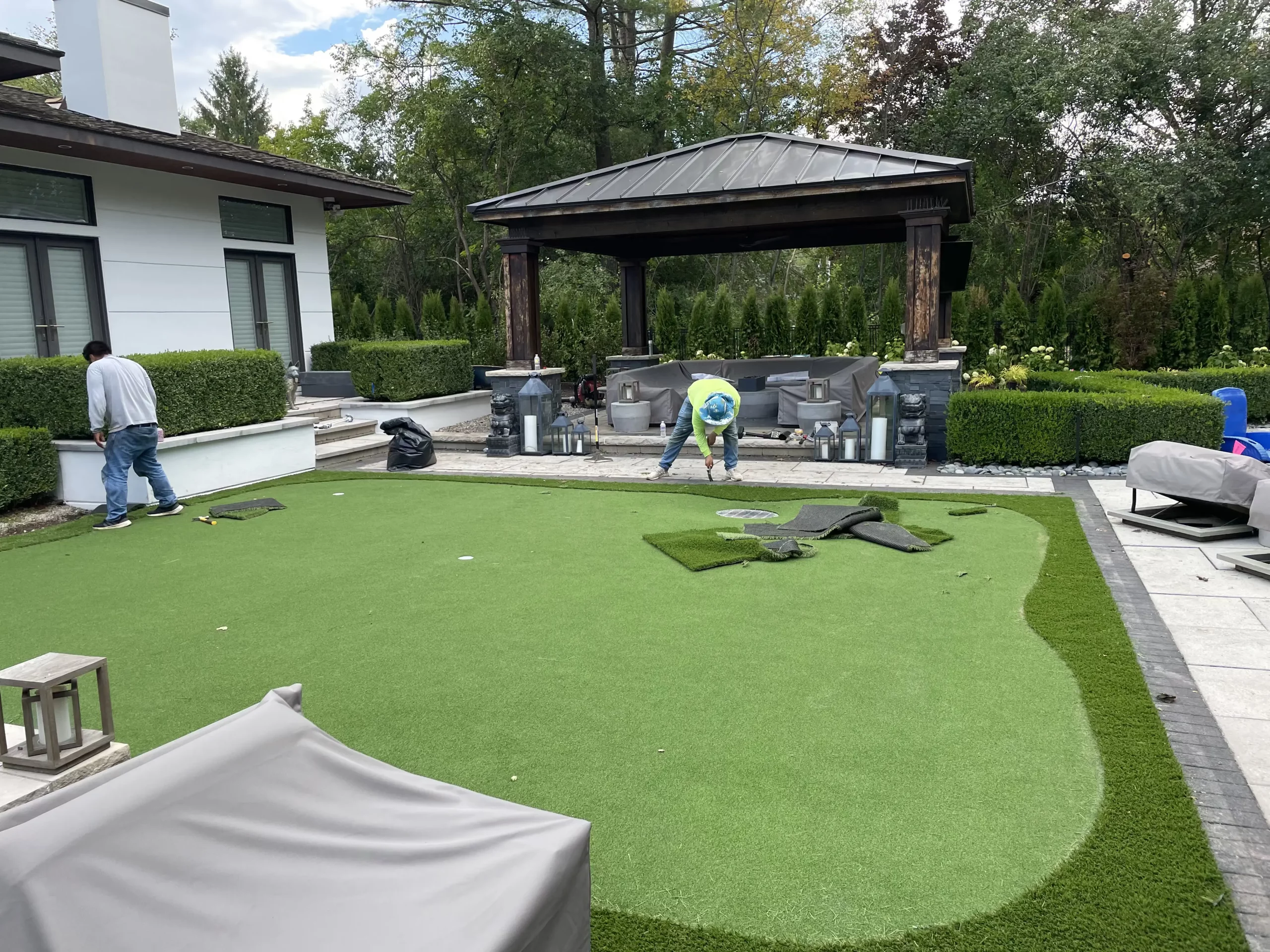
Synthetic putting greens in residential settings require a different set of engineering decisions than flat-surface turf installations. The contour — the grade changes that create break and slope on the putting surface — must be designed and built before the putting green fiber is installed. A contour that is designed after the fact, by shimming or raking aggregate unevenly, produces a surface with inconsistent ball roll behavior that does not replicate a real golf course green. The contour plan is the first deliverable in a putting green project, and it is built on the ground in aggregate before the fiber is cut.
Ball roll consistency on a synthetic putting green is determined by the fiber pile height, the infill depth, the surface uniformity of the contour, and the face weight of the putting green fiber — not by the putting green fiber brand name alone. Artificial Grass of League City specifies putting green fiber by pile height (typically 3/8 to 1/2 inch for residential greens), face weight (minimum 50 ounces for residential, 60 ounces for commercial or practice-intensity greens), and the documented stimp rating the fiber achieves at a given infill depth. That stimp rating — the standardized measure of green speed — is part of the product spec included in the install file.
Drainage under a putting green is a critical specification that is frequently undersized. A Gulf Coast putting green receives significant rainfall during the season, and standing water on the surface degrades both the fiber and the base. The drainage rate through the putting green system — calculated as inches per hour through the drainage mat and the aggregate base — is specified at project planning and verified with a field test before the contour base is built.